

7 tours
Guided Temple Tours
Guided temple tours, from old city walks and Doi Suthep to full days beyond the walls.
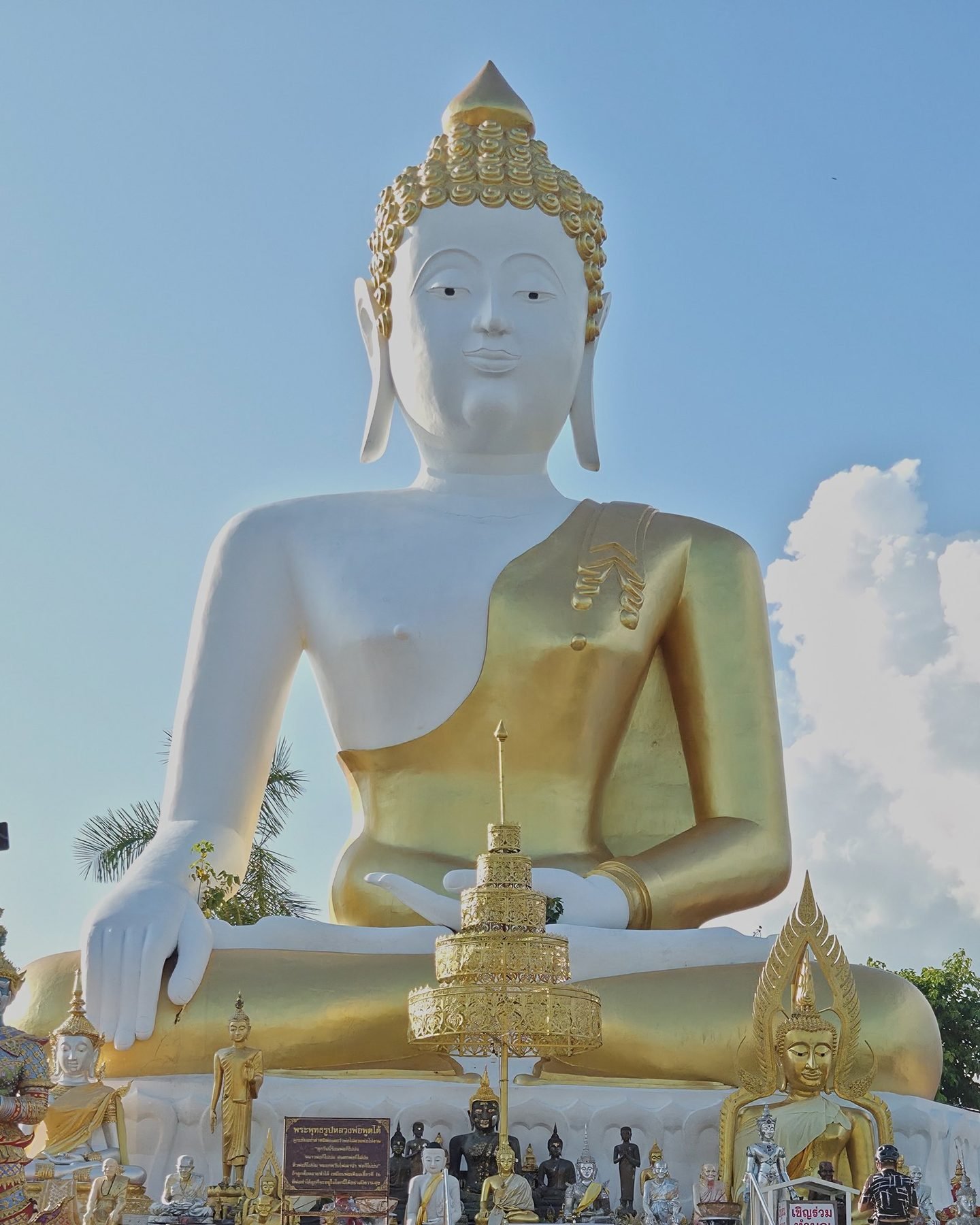
Mae Hia, Chiang Mai
On a hill south-west of Chiang Mai, a big white Buddha can be seen from afar. In an open hall, a small gilded statue, Luang Pho Than Jai, receives vows and, once they are granted, jasmine.
The temple is named after its relic chedi, the phra that, and after its hill, Doi Kham. Many of the people who climb it, though, come for something else: to make a vow to a small gilded statue, Luang Pho Than Jai.1
This page follows the vow as the temple posts it in the hall, from the request to the return with jasmine, then walks round the rest of the summit: the chedi and its history, the statues, the view and the practical details.
Our take: A real favourite of ours. Less famous than Doi Suthep, Wat Phra That Doi Kham is well worth the trip: the big white Buddha, a forecourt crowded with statues and gilding, and a wide view over the plain of Chiang Mai. What stayed with us most, though, is in a more modest hall: Luang Pho Than Jai's, where cones of jasmine are stacked on the platform. If you are exploring the south-west of the city, around Royal Park Rajapruek, it would be a shame to pass so close and not go up. Allow about an hour on site, more if you like to take your time over the view.
The big Buddha watches over the plain. The small one hears the requests.

The big Buddha is officially named Phra Phuttha Naphi Si Phing Rat. A donation sign on site names it Luang Pho To: luang pho, 'venerable father', is a title of respect for senior monks and revered Buddha images, and to means big.
Luang Pho Than Jai is on another scale altogether: a gilded stucco Buddha about 60 cm high, in a small shrine in the middle of an open hall where people sit on the floor.1
Today than jai is understood as 'in time', a wish granted quickly. A Thai academic study published in 2024 traces the name to an older northern Thai practice: a phra chao than jai is an image made in a single day, and finishing it in time was put down to divine help.1

In the hall, a banner explains in Thai how to make a vow, and how to come back once it has been granted.


Transcribed from our photograph of 28 October 2026. The frame cuts off the end of each line, and we have not filled anything in. The translations are ours, checked against versions of the same text published in the Thai press; they have not been reviewed by a Thai speaker.2,3
Ask
ไหว้สาขอพรหลวงพ่อพระเจ้าทันใจ จุด
Pay homage to Luang Pho Phra Chao Than Jai and ask for his blessing. Light […]
Luang Pho Phra Chao Than Jai is the statue's full name on the banner; the plaque by the shrine says simply Luang Pho Than Jai. จุด means 'to light'; the rest of the line is out of frame.
ตั้งนะโม 3 จบ แล้วว่าคาถา
Recite the namo three times, then say the verse […]
The namo is the homage to the Buddha that opens most recitations. We stop the line here: one letter of the next word is unclear on our photograph, and the frame cuts the verse. The plaque by the shrine gives it in full: โอมนะโม พุทธายะ ยะอะสะ สุมัง จะปาคะ. It opens with 'Om, homage to the Buddha', and is recited as it stands; the 2024 study glosses it as 'may whatever I ask come true'.1
แล้วบอกชื่อเรา ข้าพเจ้าชื่อ............และเล่าเรื่องที่เราจะขอให้ละเอียด เสร็จแล้วบอกหลวงพ่อพระเจ้าทันใจ
Then give your name ('My name is …') and describe in detail what you are asking for. When that is done, tell Luang Pho Phra Chao Than Jai […]
Promise
เมื่อข้าพเจ้าสำเร็จแล้วจะมาถวายดอกมะลิจำนวน 50 พวงขึ้นไป ถ้าเราจะให้มากกว่านี้ก็บอกท่านไปเลย
'When I have succeeded, I will come and offer jasmine flowers, fifty garlands or more.' If you mean to give more than that, tell him straight away […]
ถวาย (thawai): to offer, the verb used for monks and sacred images. The number, 50, is written in figures on the banner.
Come back
กล่าวเหมือนครั้งแรก แล้วบอกข้าพเจ้าได้นำดอกมะลิมาแก้บนแล้วตามที่ข้าพเจ้าสัญญาไว้
Say the same words as the first time, then: 'I have brought the jasmine to fulfil my vow, as I promised.' […]
แก้บน (kae bon): to fulfil a vow, by giving what you promised once the wish has come true.
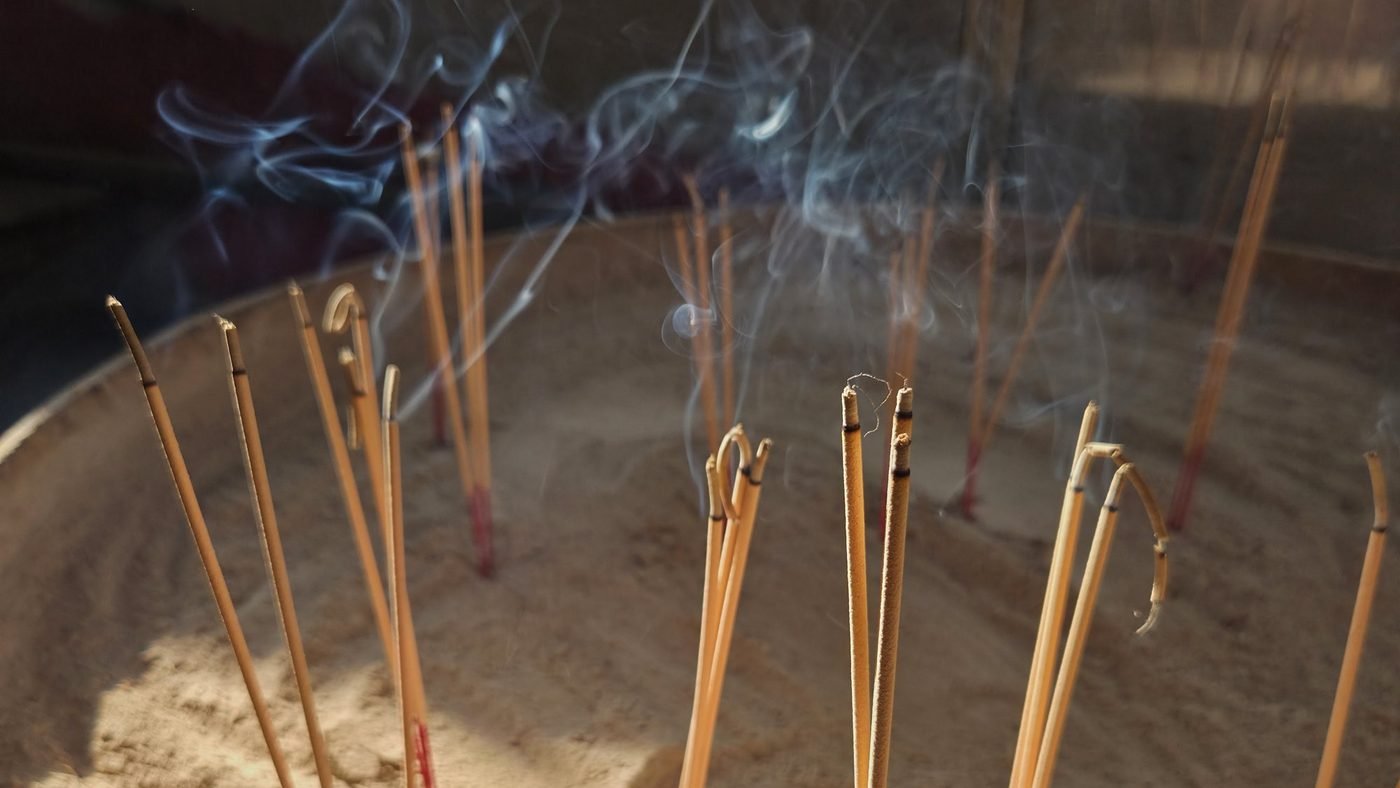
Then you wait.
50 or more

Many of the cones on the platform are probably promises kept; we did not see who left them, or why. It is a kind of ex-voto that wilts: the garlands are later dried, and the temple advises against brewing them as tea, as the flowers may carry pesticides.3
Luang Pho Than Jai was revered before the jasmine vows. The abbot says the idea came to him in a vision in 2012. He also tells of a businessman who had been cheated, got his money back within seven days and returned with 100,000 garlands; the story then spread through the press and social media.1
In November 2022 one worshipper brought 429,000 garlands; that day the abbot told The Nation that most people asked for success in business, or for money.4
The temple dates its founding to 687. Almost everything you see was built in the last sixty years.
Tradition places the founding in the reign of Queen Chamadevi of Hariphunchai, the kingdom of the Mon people centred on present-day Lamphun, south of Chiang Mai. Her two sons, Mahantayot and Anantayot, are said to have built a chedi here (the bell-shaped relic monument of northern Thai temples) to enclose an older reliquary.2,5 No archaeological dating has been published that we know of, and no historian has confirmed the date of 687.
The name has a legend of its own, set even earlier. The Buddha is said to have come to this hill, converted a yakkha couple (giants of Buddhist legend), Pu Sae and Ya Sae, and given them some of his hair. Heavy rain then washed gold into a cave on the hill: doi means mountain, and kham gold.2,5

A plaque by the chedi's stair, whose balustrades take the form of nagas (mythical serpents), names hair relics, kesa-dhātu, in a verse of homage in Pali, the language of early Buddhist texts. A second plaque addresses relics of the Buddha and of his enlightened disciples.
The chedi you see today dates from after 1966. That year, with the temple abandoned, its relic chamber was found open; among the objects recovered from it, and kept by the temple, were a large gilded sandstone Buddha, Phra Rot Luang (not the big Buddha on the summit), and clay votive tablets.2,6 Accounts differ on the cause: some blame rain and a collapse, a Thai blog blames looters.6,7 According to the temple's history plaque, the sheathing of the chedi was part of the restoration that began in 1981.6,8
Once a year, on the seventh and eighth days of the waning moon after Visakha Bucha (the full moon that marks the Buddha's birth, enlightenment and death), the relics are ritually bathed. The date follows the lunar calendar and falls in late May or June.9
Sixty years of building
1981
1994
Documented.The hall with the double naga stair
Its gable gives the date, 16 July 2537 in the Buddhist calendar, and the name of the group that led the building. It is not Luang Pho Than Jai's hall; we call it the 1994 hall.
1995
1997
Single source, or sources that differ.Luang Pho Than Jai gilded
Until then the statue was plain white lime plaster.1
2024–2025
Documented.Thao Wessuwan
Work on a giant gilded statue of Thao Wessuwan (Vessavana in Pali, guardian of the northern quarter and giver of wealth in Buddhist tradition) is halted in August 2024, amid public debate about its size and its place beside the chedi. The municipality issues a permit in December, and the statue is consecrated on 8 April 2025.12,13,14


Work on the 1994 hall goes on. Next to its door, a donation box reads 'gilding, burying the luk nimit': the stone balls buried around an ordination hall to mark its sacred boundary. At the foot of the stair, ropes hang from a bar under a small sign, 'ball no. 2, east, in homage to Aññā Koṇḍañña', the Buddha's first disciple. The hall may be, or may be about to become, an ordination hall; we could not confirm it, nor find out when the balls will be buried.
The summit is crowded with figures, old and new: take the time to walk all the way round it.
Pu Sae and Ya Sae, the yakkha of the legend, are still honoured as guardian spirits of Chiang Mai. The temple has altars to them, and another stands by the road up the hill.6,15 Every year in late May or June, an offering ceremony is held for them at the foot of the hill, not at the temple; in 2026 the Mae Hia municipality held it on 30 May at a Doi Suthep-Pui National Park station.15,16 The rite blends older beliefs of the Lua, a people settled in the region before the northern Thai, with Buddhist practice: a procession behind a painted cloth of the Buddha, prayers, a medium and the offering of a buffalo.16,17
On the back terrace lies a reclining Buddha with a white face and a gilded robe. At its foot, two plaques carry prayers to Guanyin, the Chinese bodhisattva of compassion, and to Ganesh, the elephant-headed Hindu god of beginnings. Elsewhere on the summit, gilded yakkha guardians each hold a club.

The doorway of the 1994 hall is worth a stop: two painted scenes from the Buddha's life, a gilded peacock on an arch of mosaic, and carved doors.
Look closer: the doorway of the 1994 hall

The view alone is worth the climb. A gate on the edge of the summit, signed 'Doikham Panorama View Point', opens onto the plain: Chiang Mai's towers to the east and, by several accounts, the airport.11,18 Two gilded figures carrying baskets, a large teddy bear in glasses and a few rabbit figurines keep it company.
The hill lies west-south-west of the city, so the view faces east, with the late-afternoon light behind you. The sun sets behind the hill and the temple closes at 18:00: this is not a sunset spot.

Checked in October 2026.


Dress
Shoulders and knees covered
The sign rules out shorts, short skirts, strappy or strapless tops and bare midriffs, says sarongs are available at the entrance, and bans pets.
The temple is about 15 km by road from Tha Phae Gate, beyond Royal Park Rajapruek: around 25 minutes without traffic. A road climbs to a car park near the top. No regular songthaew (shared pick-up) runs there from the city: take a Grab (the ride-hailing app widely used in Thailand) or a taxi, or hire a red songthaew for the round trip and ask the driver to wait. You cannot count on finding a car at the top for the way down: either keep your driver, or allow time to wait for a ride.
A path with a long stair climbs from a car park at the foot of the hill, on the Mae Hia side: about 1.5 km and an hour with rests, as described in 2021.21,22 Accounts of the number of steps disagree widely, and some count only the section lined with nagas.21,23 People still used the path in 2026, but we have not walked it, and in 2021 its lower part was partly bare laterite, red stony ground. Red songthaew have run shuttles from the lower car park to the top, at 20 baht a trip in 2019 and in one visitor's account from 2026; we cannot say whether they run every day.24,25
Entry is free.18 You do not need to buy anything, either to visit or to make a vow. Garlands are sold along the access road; in 2023 a long one cost about 8 baht and a short one 4 to 5. Prices may have changed, so ask before you buy.3
Weekdays are usually calmer. The hall is busiest at weekends, on Buddhist holy days and on the eve of the national lottery draws, normally held on the 1st and the 16th of the month: the temple has a reputation for lottery luck, the press publishes numbers associated with it and ticket sellers set up in the car park. Queues of cars have been reported on the access road on those days.3,26
Allow about an hour on the summit. If you walk up, add an hour or more for the climb, and time for the walk down. Royal Park Rajapruek is next door. The temple on Doi Suthep is on the same range, about 5 km north as the crow flies, but it is a separate trip.
How old is Luang Pho Than Jai?
Sources give anything from 500 to 1,300 years, and we found no dating published by an art historian.
When was the big Buddha built?
It appears in photographs from 2009; we found no reliable earlier date.27
How tall are the big Buddha and the Wessuwan statue?
Published figures disagree, and we did not measure them.
How many steps does the climb from the foot have?
Counts differ, and we do not know what state the lower path is in today.
What opened the relic chamber in 1966?
Rain or looters: the accounts disagree.
Is the 1994 hall an ordination hall?
The donation box and the ropes suggest it is, or is to become one; we do not know when the luk nimit will be buried.
The photographs and signs come from our visit on 28 October 2026. Distances and travel times are our own calculations on OpenStreetMap, rounded. History, the rite and practical details come from the sources below, consulted in October 2026; where they disagree, the page says so. For the Thai, see the note under the banner. Numbers in the text refer to this list.
7 tours
Guided temple tours, from old city walks and Doi Suthep to full days beyond the walls.